




Education is the foundation upon which an individual matures and a society advances. With countries closely tied to the progress of national education programmes, ASEF has set in motion a series of programmes bolstering collaboration among academic institutions, education networks, and the society at large from across Asia and Europe. ASEF’s array of workshops, seminars and conferences continue to foster academic discourse and intercultural exchanges which have resulted in the implementation of policy recommendations and best practices at participating institutions and beyond.
 20-29 May 2012
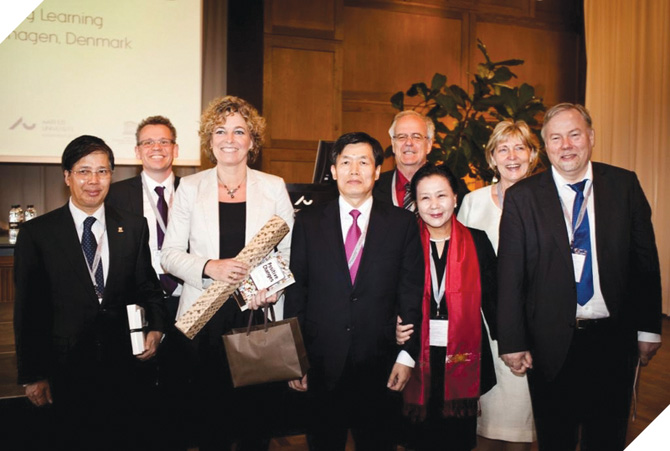
Copenhagen, Denmark In May the ASEM Lifelong Learning Hub (ASEM LLL Hub) organised the conference ‘Learning Unlimited’ in response to the call of the ASEM Ministers for Education at their meeting in Copenhagen, Denmark in 2011 to ‘enhance understanding and cooperation in the field of lifelong learning’ as well as to commemorate the 40th anniversary of the visionary UNESCO report, ‘Learning to Be’. The event aimed at creating new visions and effective models for lifelong learning in light of the current economic crisis. It also served as a forum for the Hub’s Research Networks to share the latest results of their Asia-Europe joint research projects with academic communities and ministerial representatives from ASEM member countries. This project is a part of the ASEM Education Hub (AEH).
|
 |
Throughout 2012
Various ASEM Countries In 2012, 6 out of almost 40 Asia-Europe Classroom (AEC) projects were shortlisted for the AEC Awards. Among them were ‘A Magic Flight to Berlin’, ‘Homeseek II : Exploring Homes’ and ‘Windows to the Past Season 2 – A Glimpse into Our Heritage’, which received the Gold Awards. Meanwhile, ‘Crossing the Borders, Feeling the Others’, ‘Planet Happiness’ and ‘GoCyberGreen 2012’ were conferred the Merit Awards. Together, these 6 projects engaged a total of 73 educators and 891 students from 59 schools across 24 ASEM countries. In addition, new AEC projects covering various themes were submitted online. These projects are conceptualised and facilitated by secondary and high school teachers from Asia and Europe and carried out throughout 2012 and 2013. Through its activities, the AEC-NET provides opportunities for collaborative learning and intercultural exchanges between the two regions. More information is available at http://aec.asef.org
|
|
Throughout 2012
Various venues in Asia and Europe ASEF and its partners have embarked on two unique studies to gauge the perception of the EU across Asia and vice versa – ‘EU through the Eyes of Asia’ and ‘Asia in the Eyes of Europe’. Covering 10 Asian ASEM countries, namely Australia, China, India, Japan, Korea, Malaysia, New Zealand, Russia, Singapore and Thailand, the latest phase of the ‘EU through the Eyes of Asia’ project concluded in 2012. The media analysis portion alone spanned a period of six months from January to June 2011 and involved 40 media outlets, capturing and analysing over 8,000 articles related to the EU. Much of this focused on the fallout of the sovereign debt crisis from an Asian perspective. The public opinion research component saw 10,000 respondents (1,000 per country) surveyed on their perceptions of the EU in March 2012. The final element featured over 300 face-to-face interviews with national opinion leaders from the business, civil society, media and political sectors, thus providing valuable feedback from decision makers that help to shape policy and the relationship between their countries and the EU. 2012 also saw the findings of the eight-country ‘Asia in the Eyes of Europe’ research project compiled in a new publication, ‘Asia in the Eyes of Europe – Images of a Rising Giant’. The publication, along with the latest findings from the ‘EU through the Eyes of Asia’ project, were presented during a series of launch events and lectures in 10 cities across Asia and Europe in the second half of 2012. The projects’ findings received a high level of media attention and were featured in numerous articles in renowned media, including the International Herald Tribune, Asia 360 Magazine and China Radio International. 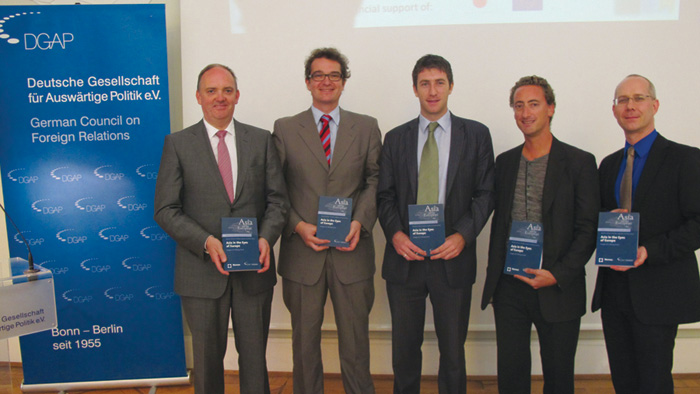
^ Official Launch of the publication by authors and partners in Berlin
|
|
The launches took place in: Singapore, 6 June 2012, in partnership with the EU Centre in Singapore and the Konrad Adenauer Stiftung (KAS) Paris, France, 18 June 2012, in partnership with French Institute for International Relations (IFRI) Brussels, Belgium, 19 June 2012, in partnership with the Brussels Institute for Contemporary Chinese Studies (BICCS) Berlin, Germany, 22 June 2012, in partnership with the German Council on Foreign Relations (DGAP) and the Konrad Adenauer Stiftung (KAS) Beijing, China, 2 July 2012, in partnership with Tsinghua University Shanghai, China, 4 July 2012, in partnership with the Consulate General of the Federal Republic of Germany - Shanghai, the Konrad Adenauer Stiftung (KAS), and Fudan University Tokyo, Japan, 5 July 2012, in partnership with Waseda University Bangkok, Thailand, 30 August 2012, in partnership with Chulalongkorn University Wellington, New Zealand, 7 November 2012, in partnership with the National Centre for Research on Europe (NCRE), European Union Centre’s Network – New Zealand (EUC N) Canberra, Australia, 9 November 2012, in partnership with the Centre for European Studies – Australia National University (ANUCES), with the support of the Delegation of the European Union to Australia and New Zealand Kuala Lumpur, Malaysia, 30 November 2012, in partnership with the Razak School of Government
ASEF is partnering with the National Centre for Research on Europe –
University of Canterbury (NCRE) for both projects, while the ‘Asia in
the Eyes of Europe’ project is additionally supported by the German
Council on Foreign Relations (DGAP), Konrad Adenauer Stiftung (KAS)
and Tsinghua University. Each project counts on the valuable support
of local research partners in each location.
|
|
Throughout 2012
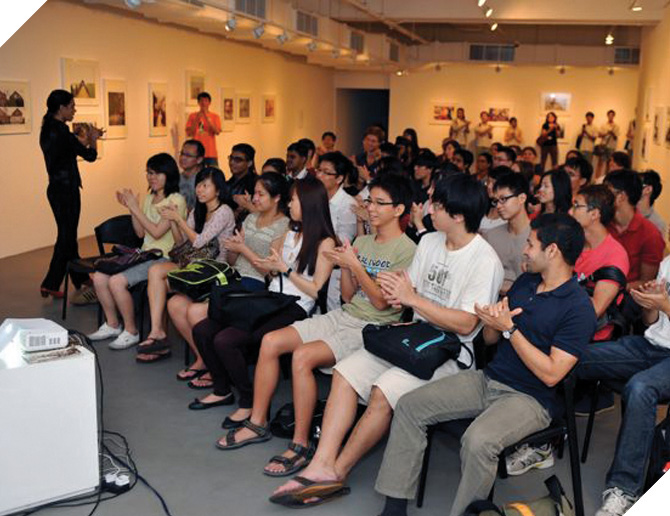
Various ASEM Countries 41 students and young professionals from 31 ASEM countries collaborated on an exhibition entitled ‘Shared Heritage: As We See It’. Showcased alongside the 5th Culture Ministers’ Meeting (CMM) in Indonesia in 2012, it highlighted the meaning of shared heritage as seen through the lens of the participants of the 17th ASEF University (AU17). The exhibition is the final output of AU17, a project organised in response to the priorities identified by ASEM leaders at the 4th CMM in 2010 in Poznan, Poland. Thus far, the exhibition has travelled to Budapest, Hungary (December 2011), Bucharest, Romania (January 2012), Singapore (May 2012), Manila, The Philippines (August 2012) and Yogyakarta, Indonesia (September 2012). |
|
  
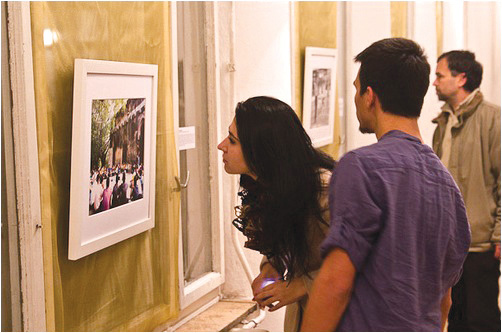 ^ 17th ASEF University Travelling Exhibition in Hungary
|
|
17 May – 7 November 2012
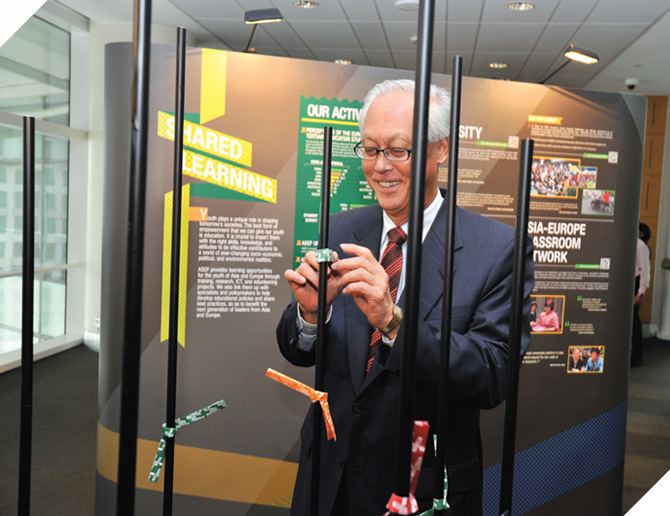
Singapore / Lao PDR The ASEM Travelling Exhibition, ‘Connected Histories, Shared Future’ commemorated ASEF’s 15th Anniversary. Produced in 2012, the exhibition ran from May to November in both Singapore and Lao PDR, celebrating 15 years of efforts to connect the two diverse, vibrant continents of Asia and Europe. The exhibition was opened by former Prime Minister of Singapore, Mr Goh Chok Tong, on 17 May 2012 at the National Library Building in Singapore. The exhibits travelled to various public libraries where they were viewed by more than 50,000 visitors. The exhibition was later presented at the 9th Asia-Europe Meeting Summit of Heads of State and Government (ASEM 9) from 2-7, November in Vientiane, Lao PDR and viewed by over 2,000 international delegates. |
|
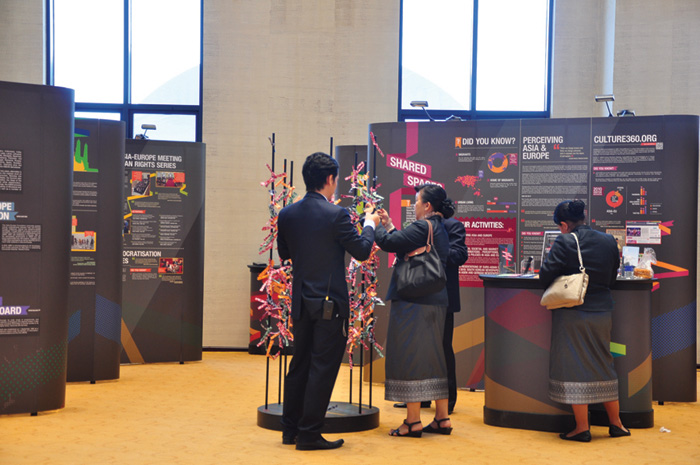
^ The ASEM Travelling Exhibition at the 9th ASEM Summit |
21 May 2012
The Hague, The Netherlands Discussions thrived at the 5th ASEF University Alumni Network (ASEFUAN) Dialogue. Under the theme ‘Re-emerging Asian Actors and International Law: Asian and European Perspectives on the International Criminal Court (ICC)’, the debate covered legal and political perspectives of Asian and European countries on the ICC, the impact of the rise of Asian actors on the ICC in particular and on international law in general. The Dialogue, which also examined the future challenges for the ICC and the general application of international criminal law, was attended by 27 experts from the International Criminal Court (ICC), The International Criminal Tribunal for the former Yugoslavia (ICTY), and the Embassies of Japan, Australia, Indonesia and Vietnam. The Dutch Ministries of Foreign Affairs, of Security and Justice, and of the Interior and Kingdom Relations were also represented. 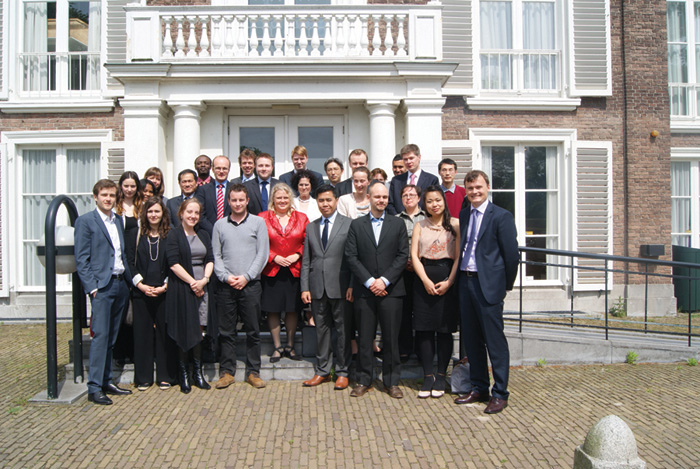
^ Participants of the 5th ASEFUAN Dialogue at The Netherlands
Institute of International Relations Clingendael (Photo courtesy of the
Clingendael Institute) |
|
31 July - 2 August 2012
Quezon City, The Philippines and Europe came together for the two-day 11th ASEF University Alumni Network (ASEFUAN) Annual Academic Conference and General Meeting. Themed ‘Conflict Transformation and Peaceful Settlement of Disputes in Asia & Europe’, the event was also attended by ASEFUAN members from 24 ASEM countries, select non-ASEFUAN participants involved in sustainable peace, as well as students and faculty from local universities. Apart from the academic conference, the network’s General Meeting was also held, during which ASEFUAN’s Executive Committee members for 2012 to 2013 were elected. 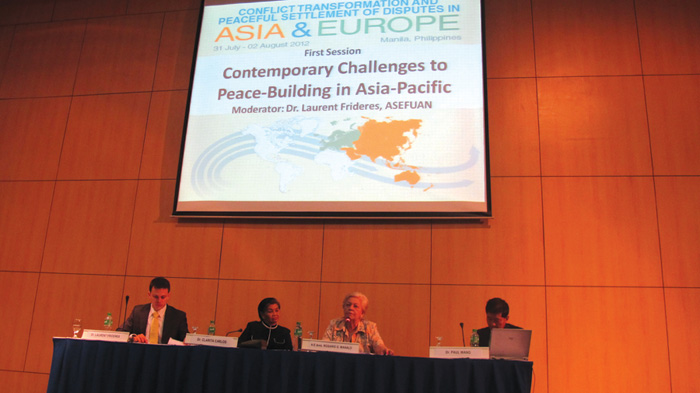 ^ (L-R) Dr Laurent Frideres (ASEFUAN), Dr Clarita Carlos (Ateneo
de Manila University), Amb. Rosario Manalo (ASEF Governor for The
Philippines) and Dr Paul Wang (Nankai University) during the plenary
on Contemporary Challenges to Peace-Building in Asia-Pacific
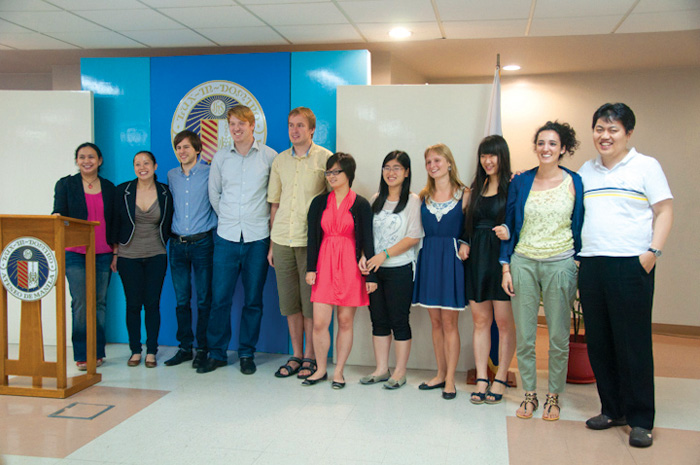 ^ Outgoing (2011-2012) and incumbent (2012-2013) members of
ASEFUAN’s Executive Committee (EXCO) |
|
24 September 2012
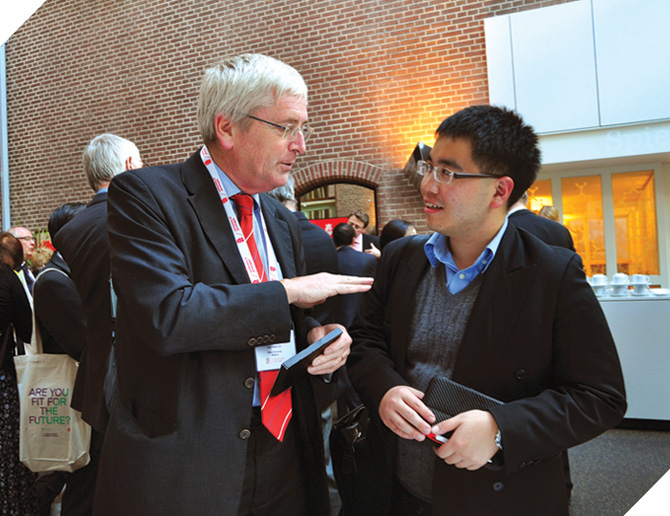
Groningen, The Netherlands The 1st Asia-Europe Students’ Forum was launched as part of ASEF’s efforts to integrate student participation into the ASEM Education Process, particularly into the agenda of the ASEM Rectors’ Conference (ARC) series. Some 50 students from 37 countries came together and shared their views on the question, ‘Are You Fit For The Future?’ to contribute to the on-going dialogue on employability and entrepreneurship education as well as the evolving role of universities in providing graduates with skills for life and employment. The results of their |
|
discussions were presented at a plenary session during the 3rd ASEM Rectors’ Conference (ARC 3) and will be conveyed to the ASEM Education Ministers at their 4th Meeting (ASEMME4) in May 2013 in Kuala Lumpur, Malaysia. The 1st Asia-Europe Students’ Forum was jointly organised with the
ASEAN University Network (AUN) and University of Groningen (RUG ). This project is a part of the ASEM Education Hub (AEH). |
| 25-26 September 2012
Groningen, The Netherlands The 3rd ASEM Rectors’ Conference (ARC3) engaged some 150 university leaders, representatives of ASEM higher education institutions, the business community, and students from 41 countries. The conference was in response to the call of the ASEM Education Ministers at their Meeting in Copenhagen, Denmark, in 2011 to advance the dialogue on higher education-business cooperation among education stakeholders. Throughout the conference, ASEM university leaders deliberated on the models of and best practices in university-business cooperation, community engagement, and university social responsibility (USR). Participants also explored how collaboration in these fields can be strengthened across borders, including state-of-the-art approaches to teaching creativity and entrepreneurship education. In fostering enhanced university-business cooperation and universitycommunity engagement, the findings from the 1st Asia-Europe Students’ Forum were presented during one of the plenary sessions. Recommendations from the ARC3 will be presented to the 4th Asia-Europe Meeting of Ministers for Education (ASEMME4) in May 2013 in Kuala Lumpur, Malaysia. ARC3 was jointly organised with the ASEAN University Network (AUN)
and University of Groningen (RUG ).
This project is a part of the ASEM Education Hub (AEH). 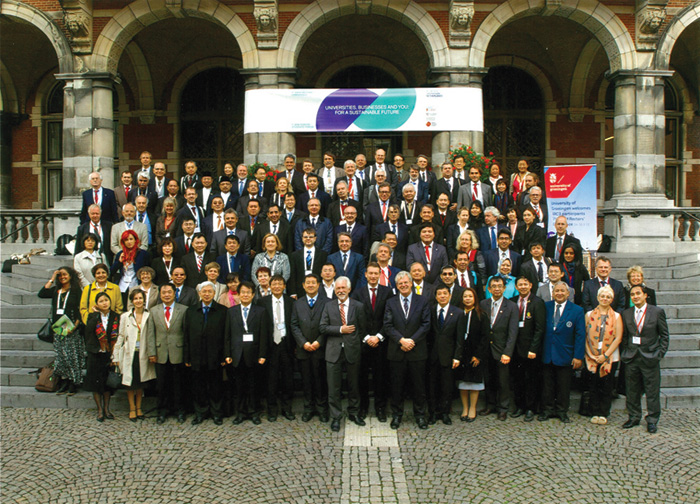
^ 3rd ASEM Rectors’ Conference participants pose for a group
photo outside the Academic Building, University of Groningen,
The Netherlands
|
|
27 September 2012
Groningen, The Netherlands The Advisory Committee of the ASEM Education Hub (AEH) provides strategic advice and ideas in order to create an impact on the longer-term perspective of the AEH and its contribution to the ASEM Education Process. Organised in cooperation with the University of Groningen (RUG), the 6th AEH Advisory Committee Meeting reviewed AEH’s programme of activities in 2011 and 2012 as well as the work plan for 2013 and 2014. Special attention was given to two upcoming projects: the 3rd Asia-Europe Education Workshop (Thailand, 2013) and the 4th ASEM Rectors’ Conference (Thailand, 2014). As of 2012, the AEH Advisory Committee is comprised of 20 member institutions, represented by higher education cooperation experts and representatives of leading academic networks and universities in ASEM countries. |