SUSTAINABLE DEVELOPMENT
Since its inception, the Asia-Europe Foundation (ASEF) has initiated several dialogue platforms amongst stakeholders in Asia and Europe on sustainable development and environmental issues. One such initiative is the Asia-Europe Environment Forum (ENVforum), established in 2003, which collaborated with top environmental institutions to work on pertinent sustainable development issues. Currently, the ENVforum's main focus is on the post-2015 development agenda, specifically towards the need for Sustainable Development Goals (SDGs) to replace the outgoing Millennium Development Goals (MDGs).
At the 9th Summit of the Asia-Europe Meeting (ASEM9 Summit), which took place in November 2012 in Lao PDR, Asian and European leaders supported the call for a set of universally applicable SDGs and also emphasised the need for an inclusive process in their elaboration. In line with its mandate, the ENVforum responded to this call of the ASEM leaders. It undertook a consultative project on SDGs, contributing to the global debate on the post-2015 development agenda.
Asia-Europe Environment Forum (ENVforum) events:
Expert Consultation on Knowledge and Capacity Needs for Sustainable Development in the Post-Rio+20 Era
4-5 March 2013
Korea


Conference on Green Growth and Sustainable Development Goals: A Development Agenda for Post-2015
4-5 November 2013
Korea
Side-events & Launch of
the Small Planet Report:
Asia-Pacific Ministerial Dialogue: From the Millennium Development Goals to the United Nations Development Agenda beyond 2015
28 August 2013
Thailand
Budapest Water Summit
8-11 October 2013
Hungary
Conference on Sustainable Development Goals (SDGs) in the Context of the Post-2015 Development Agenda
16 December 2013
Thailand
Partners:
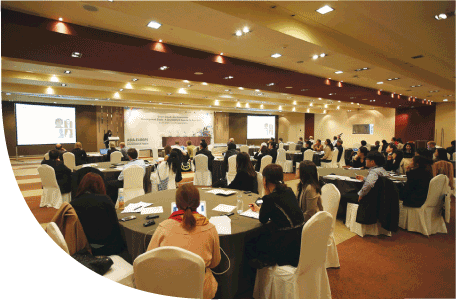
The ENVforum's conference on Green Growth and Sustainable Development Goals - A Development Agenda for Post-2015 was part of a contribution to a world-wide effort to address challenges to sustainable development goal implementation. This final event of the ENVforum in 2013 was co-organised by ASEF and the ASEM Small & Medium Enterprises Eco-Innovation Centre (ASEIC) in Seoul, Korea. Focusing on the obstacles hampering the realisation of a greener future, the conference gathered experts from the fields of business innovation and academia, representatives of small and medium enterprises (SMEs) and renowned international experts on sustainable development. Participants had the opportunity to cement their knowledge on Green Growth, SDGs and the Post-2015 Sustainable Development Agenda.
Throughout the year, several events were organised to launch the report, Sustainable Development Goals for a Small Planet: Connecting the Global to the National Level in 14 Countries of Asia-Pacific and Europe. This report was jointly produced by the ENVforum, IISD-Europe, the Earth Council Asia-Pacific, the Public Strategy for Sustainable Development, and the Institute for Global Environmental Strategies (IGES). The presentation of the report was followed by discussions on challenges related to the means of implementation. Some challenges identified and discussed include:
- Achieving SDGs will be more
challenging than creating/
agreeing on Millennium
Development Goals (MDGs)
since they are expected to
address broader issues that
may be perceived as barriers to
economic growth; and
- Areas related to SDGs are
already covered by a sprawling
number of international
agreements, most of which
have been ineffective.
The discussions concluded that the Asian-European dialogue can support the mobilising power of a globally agreed set of SDGs, if these are restricted to a limited number of 'high-priority' areas, easily monitored and matched with adequate implementation resources. The participants also emphasised that the success of SDGs greatly depends on governance and available funding.
The Asia-Europe Environment Forum (ENVforum) was actively engaged in the global debate over the future set of Sustainable Development Goals (SDGs) in 2013. A series of consultations reinforced with research was conducted to contribute to the shaping of the post-2015 development agenda to formulate a set of global goals.
The ENVforum co-organised an Expert Consultation on Knowledge and Capacity Needs for Sustainable Development in the Post-Rio+20 Era in Korea. Representatives from over 50 countries and 45 experts from United Nations Agencies and various institutions participated. A Framework for Action took form in this meeting. It aims to align knowledge-sharing and capacity-building efforts with emerging needs, as the international community transits towards a new set of global SDGs.
The ENVforum conducted a research project to identify best practices in sustainable development with particular relevance for the creation of SDGs. The study proposed a methodology that allowed for the development and application of a set of illustrative goals and indicators based on existing experience at national and international levels. Specifically, the research:
- examined national strategies for (sustainable) development/green growth or similar plans, strategies as well as their monitoring and evaluation tools in selected ASEM countries;
- proposed a set of SDGs and associated indicators based on country cases; and
- identified implementation challenges at a national level.
The work was conducted by the International Institute for Sustainable Development Europe (IISD-Europe; Switzerland), the project leader, the Earth Council Asia-Pacific (Philippines), and the Public Strategy for Sustainable Development (Belgium) in collaboration with the Institute for Global Environmental Strategies (Japan) and the Asia-Europe Foundation (ASEF). The selected ASEM countries for this research were Australia, Bangladesh, China, India, Indonesia, Japan, Korea, and Singapore in Asia and France, Germany, Hungary, Poland, Sweden, and Switzerland in Europe.
9th ASEF Journalists' Colloquium
9-12 November 2013
India
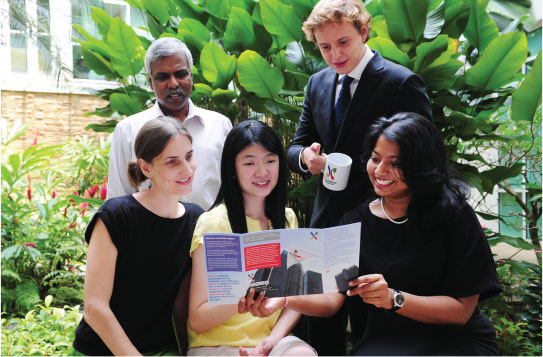
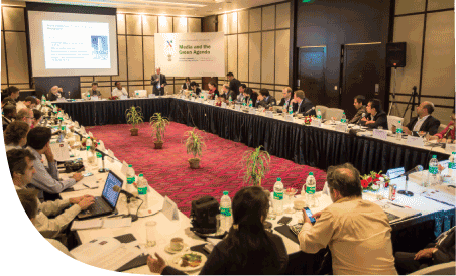
The 9th ASEF Journalists' Colloquium, Media and the Green Agenda, which was organised in conjunction with the 11th ASEM Foreign Ministers' Meeting, gathered some 38 senior journalists as well as media and environmental experts from 29 ASEM countries. They shared their experiences in environmental issues, namely Sustainable Development Goals (SDGs), energy, green growth, and poverty reduction. Journalists discussed editorial challenges, new methods of reporting and verification, and new perspectives on sustainable development issues that can improve their reporting.
The inputs of the colloquium will be compiled into a Handbook for Journalists, which include suggestions on how to improve reporting on sustainable development and on what environmental organisations can do to raise media attention.
Participants of the 9th ASEF Journalists' Colloquium on Media and the Green Agenda
Partner:

ASEF Green Action (18th ASEF University)
Throughout 2013
Brunei Darussalam,
China, Hong Kong SAR, Indonesia, Netherlands, Philippines, Poland, Spain and Thailand
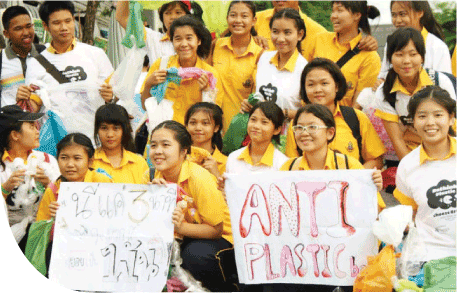
The ASEF Green Action initiative raised awareness on the harmful effects of plastic on the environment. It included a variety of activities, such as public launches, bag exchanges and workshops. The events were coordinated by selected 18th ASEF University (AU18) participants. During the bag exchanges, passers-by were invited to swap their plastic bags for reusable ones and encouraged to switch to the latter in the future. The collected items were creatively reused to promote further environmental awareness.
Partners: